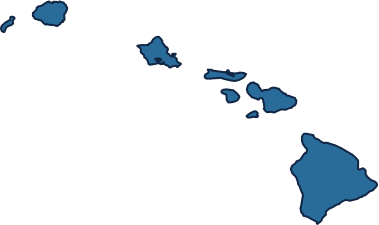
Hawi City Demographics
Hawi, a small community in Hawaii County, Hawaii, has a population of around 2,000. The median age is 49 years, reflecting an older demographic. Females comprise approximately 51%, while males are about 49%. Racially, Hawi is diverse: about 40% Asian, 20% White, 16% Native Hawaiian or other Pacific Islander, 10% from two or more races, and 14% Hispanic or Latino of any race. This blend embodies the multicultural character of Hawaii.
Hawi City Housing
Hawi, located on Hawaii’s Big Island, has a homeownership rate near 70%, with median home values around $650,000 in 2024. Rental prices average $2,000–$2,500/month for a 2-bedroom. The housing market has seen 5–8% annual price growth recently, driven by demand for single-family homes, which dominate local inventory. Neighborhoods like Hawi Town and Kapaau offer a mix of historic plantation-style houses and modern builds. Property taxes are relatively low, averaging 0.28% of assessed value, making owning appealing compared to mainland U.S. rates.
Hawi City Healthcare
Hawi, a small town on Hawaii Island, relies on Kohala Hospital (28 beds) for acute and emergency care, along with Kohala Family Health Center and rural clinics. The population (ca. 2,000, median age 49) is predominantly Native Hawaiian/Pacific Islander and White. Common health issues include diabetes, hypertension, and heart disease, reflecting statewide trends. Healthcare access is limited by rural location—15% of residents are uninsured, lower than the state average (4.5%). Primary care is provided mainly by family physicians and nurse practitioners, with local provider shortages and occasional reliance on telehealth or travel to larger centers in Waimea or Kona.
Education in Hawi City
Hawi, Hawaii (ZIP 96719), features limited educational facilities, primarily Kohala High & Elementary School, serving grades K–12 with about 560 students and a GreatSchools score of 6/10. Adult residents holding a high school diploma reach 90%, while around 27% hold a bachelor’s degree or higher. Educational programs include Hawaiian language and cultural studies. School safety is generally rated above average, with low reported incidents. No colleges are located in Hawi, requiring residents to travel for higher education.
Transportation in Hawi City
Hawi, Hawaii, is a small rural town on the Big Island’s North Kohala coast. Most residents commute by car, with over 85% driving alone to work, reflecting a high vehicle ownership rate (over 95% of households own at least one vehicle). Public transit options are limited, with Hele-On Bus service as the primary provider, resulting in less than 2% usage for commutes. Average commute times are about 30 minutes. The town lacks major transportation infrastructure beyond local roads. Main employment hubs include local businesses, tourism, agriculture, and schools, primarily located within or near the community.
Popular names
- Brandi Jackson
- Briday Pinpherk
- Cherry Rivera
- Corinne Higa
- Cynthia Buchanan
- Edward Lewis
- Harold Higa
- Jerriline Tagaca
- Keao Kainoa
- Kevin Mknelly
- Margaret Kaoo
- Michael Foley
- Patrick Medeiros
- Alan Brown
- Alice Nakayama
- Alicia Ramos
- Allan Davis
- Alohilani Black
- Alterry Murai
- Amelia Rudolph
- Ana Reyes
- Andrew Thompson
- Angela Rosa
- Angelica Martinez
- Anita Godoy
- April Lee
- Ariel Medeiros
- Arun Rajagopal
- Ashley Torres
- Avelino Cubangbang
Table of Contents
Other Cities in Hawaii
- Aiea
- Anahola
- Captain Cook
- Eleele
- Ewa Beach
- Haleiwa
- Hana
- Hanalei
- Hanamaulu
- Hanapepe
- Hauula
- Hilo
- Holualoa
- Honokaa
- Honomu
- Kaaawa
- Kahuku
- Kahului
- Kalaheo
- Kaneohe
- Kapaa
- Kapaau
- Kapolei
- Kaumakani
- Kaunakakai
- Keaau
- Kealakekua
- Kekaha
- Kihei
- Kilauea
- Koloa
- Kualapuu
- Kula
- Kurtistown
- Lahaina
- Laie
- Laupahoehoe
- Lawai
- Lihue
- Makawao
- Maunaloa
- Mililani
- Mountain View
- Naalehu
- Paauilo
- Pahala
- Pahoa
- Paia
- Papaikou
- Pepeekeo
- Princeville
- Pukalani
- Schofield Barracks
- Volcano
- Wahiawa
- Waialua
- Waianae
- Wailuku
- Waimanalo
- Waipahu